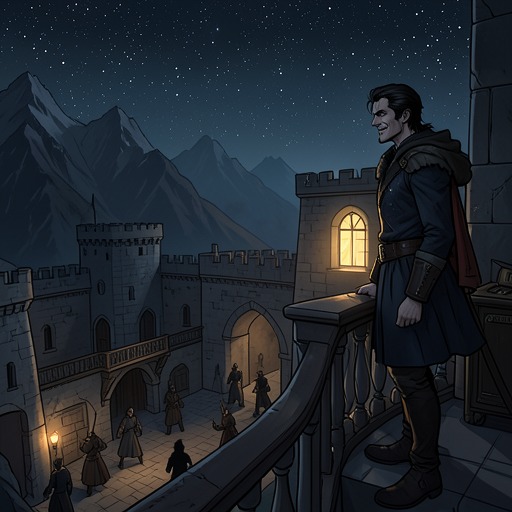
Faerie Bargains
A Court of Thorns and RosesFaerie Bargains are binding exchanges through which the faerie world converts speech into obligation and turns personal decisions into life-changing terms. Their decisive significance lies in the tension between formal choice and unequal power: Feyre Archeron is repeatedly offered alternatives, but each bargain is made under threat, captivity, bodily danger, or incomplete information. The bargains therefore function both as a magic system and as a political language, revealing who can impose rules, who may interpret them, and what freedom costs in Prythian.
Definition and Operating Principles
A bargain is not merely a promise or negotiation. It is an enforceable magical transaction whose wording determines the parties’ duties and whose consequences can exceed what a speaker intends. The Treaty establishes the harshest baseline: an unprovoked human attack on faerie-kind must be paid with a human life. Because the mercenary killed a faerie after attacking first, the faerie who comes to Feyre’s cottage presents her death as lawful repayment rather than arbitrary violence. The phrase “A life for a life” makes the exchange appear exact, but the faerie then reveals a permitted alternative: Feyre may offer her life to Prythian by abandoning the human realm and living there permanently.
The bargain’s structure depends on a distinction between lying and withholding. Faeries cannot lie, yet they can omit information, and Feyre recognizes that the faerie did not have to mention the loophole allowing residence in Prythian instead of immediate death. His offer is therefore technically truthful while remaining coercive and strategically incomplete. He grants permission for Feyre to live at his home and frames that residence as payment for the wolf’s life, but the decision is made while he blocks the door, threatens to have her shredded, and leaves her family exposed to the consequences.
The same mixture of precision and manipulation governs later agreements. The Suriel treats knowledge as something that must be exchanged: after Feyre captures it, it asks her to free it before answering her questions. Its response to her question about returning home is not a negotiable promise but a warning that departure would endanger both Feyre and her family. In this setting, information itself has a price, and the authority to answer can be used to close off an apparent route of escape.
Bargains as Thresholds
Feyre’s first bargain carries her across the Wall and into Prythian. The journey from her cottage to the southern border takes two days, after which an unguarded gate opens and her horse follows the faerie through. The crossing is presented as both imprisonment and salvation: she has escaped immediate death, but only by entering a lethal realm and forsaking the human world. The bargain thus produces an intermediate identity before Feyre has any control over what that identity will become.
Other threshold experiences reinforce the same pattern. At the Spring Court celebration, hundreds of High Fae gather behind masks while glamour prevents Feyre from seeing their features properly. She remains physically present among them but socially concealed, with her human scent and identity hidden beneath a hood and the smoke of the bonfires. Later, an invisible wall stops her horse in the forest even though faeries can pass through it. These boundaries make the logic of bargains visible: crossing is possible, but never neutral. Entry changes the terms under which a person can live, move, and be recognized.
The most extreme threshold occurs after Feyre’s death beneath the Mountain. She experiences darkness bordered with gold, struggles upward toward life and Tamlin, and wakes without pain or broken bones. The crowd witnesses that she has become High Fae. Her transformation gives material form to the bargain-like economy of sacrifice: a human life is lost, then returned in a new immortal condition, with the cost and benefit distributed through the intervention of the High Lords rather than through a simple exchange Feyre herself controls.
Amarantha’s Contractual Trials
Amarantha turns bargain-making into an instrument of sovereignty. When Feyre comes to claim Tamlin, Amarantha offers three tasks designed to test the depth of human loyalty and love. Completion is linked to Tamlin’s freedom, the breaking of his curse, and the release of his court. Amarantha also provides a second route: Feyre may answer a riddle at any time, but an incorrect answer will have fatal consequences for Clare Beddor. The arrangement appears to create options, yet every option keeps Feyre inside Amarantha’s exceptional authority.
Feyre attempts to protect herself against verbal ambiguity by specifying the terms. She asks not only for Tamlin’s curse to be broken but also for herself, Tamlin, and the entire court to leave and remain free forever. This insistence reflects what she has learned from earlier dealings: a general promise can be narrowed by a missing condition, and a bargain can be obeyed in wording while defeated in purpose. Her effort makes language an active weapon, even though Amarantha retains the greater power to determine when and how the terms will be performed.
That imbalance becomes explicit after Feyre completes the trials. Amarantha claims that Feyre did not specify when the captives had to be freed, so she may postpone their release until an unspecified future moment, perhaps after Feyre’s death. The result is a value reversal: what seemed to be a completed bargain produces not freedom but renewed danger. Amarantha’s interpretation exposes the difference between a promise’s apparent meaning and its enforceable wording, while also showing that law without an accountable interpreter can become another form of personal violence.
Rhysand’s Exchange and Bodily Cost
Rhysand offers Feyre a different but equally consequential bargain after her arm has been damaged by poisoned magic. He will heal the arm if, for two weeks of every month and for two weeks of his choosing, Feyre lives with him at the Night Court after the three trials. Feyre initially refuses, unwilling to repeat the mistake of accepting a faerie agreement without understanding its burden. Rhysand presses her, and she negotiates the duration down to one week. When she accepts, the bargain becomes physically manifest: magic stirs between them, and Rhysand heals her through a violent transformation of shattered bone and flesh.
The exchange demonstrates both the usefulness and danger of precise negotiation. Feyre cannot erase the imbalance between them, since she is feverish, injured, imprisoned, and dependent on his power. She can, however, alter the term that governs her future. The final agreement binds her to the Night Court for one week each month, creating an obligation that will continue beyond the immediate crisis. Healing is not a gift but a service purchased with recurring access to Feyre’s time and presence.
The bargain also complicates the meaning of consent. Feyre says the final words accepting the deal, but the choice is constrained by pain and the need for immediate restoration. Its magical force does not prove that the exchange was equal; it proves only that the terms were accepted and activated. In this world, enforceability can coexist with coercion, and a formally valid bargain may preserve the very hierarchy that made refusal nearly impossible.
Political and Thematic Significance
Faerie Bargains connect private speech to the larger history of Prythian. The Treaty supplies the language of reciprocal punishment, while Amarantha’s conquest reveals how rules can be hollowed out by a ruler who controls their interpretation. She spent decades building trust, infiltrated the High Lords’ gathering, stole their powers, and ruled Prythian for forty-nine years. Her later manipulation of Feyre’s agreement repeats that political pattern on an intimate scale: the text of an obligation remains visible while its humane purpose is suspended.
The bargains also dramatize the recurring movement from one realm or condition to another: human to faerie territory, freedom to captivity, ignorance to dangerous knowledge, injury to healing, death to High Fae immortality. Each transition demands payment, and each payment changes the person who makes it. Feyre’s survival depends on recognizing that apparently absolute choices may contain alternatives, yet her growing skill with wording never fully protects her from those who possess greater magical and political power.
As a narrative device, the bargains give the fantasy’s magic a comprehensible limitation: power acts through stated terms, but those terms are vulnerable to omission, timing, and authority. Their dramatic force comes from the gap between what a character believes has been promised and what the words can be made to mean afterward. A bargain may save a life, open a border, provide forbidden knowledge, heal a body, or promise liberation; it may also convert that rescue into permanent obligation. The recurring question is not simply whether a promise will be kept, but who controls the definition of keeping it.